


Taking the Time for You.

Florida Ridge is one of the most densely populated unincorporated communities in Indian River County, and its housing stock tells the story of a working neighborhood that has been home to families for decades. Most of the homes here were built during the 1970s through the 1990s, and a good number of them are still running the original ductwork and air handler configurations from when they were constructed. In a climate like this one, that kind of age on a system gets noticed fast when summer arrives. Bates Air and Heat is a veteran-owned HVAC company serving Florida Ridge and the broader Indian River County area. We understand what older systems in this part of the county deal with day in and day out, and we bring that knowledge to every service call. When we show up at your home, you get a straight diagnosis, clear options, and a repair you can count on to hold.
Our technicians handle the full scope of residential AC repairs in Florida Ridge, including refrigerant leak location and recharge, capacitor and contactor replacement, evaporator and condenser coil service, condensate drain cleaning, blower motor diagnosis, and thermostat repair. We work on all standard residential split systems and the air handlers common across this part of Indian River County. Florida Ridge homes often have systems that have been layered over time, with newer thermostats or replacement air handlers paired with older line sets and ductwork. That kind of mixed-age setup requires a technician who knows how to assess the whole system rather than just the part that triggered the call. We take that whole-system approach on every job so nothing gets missed.
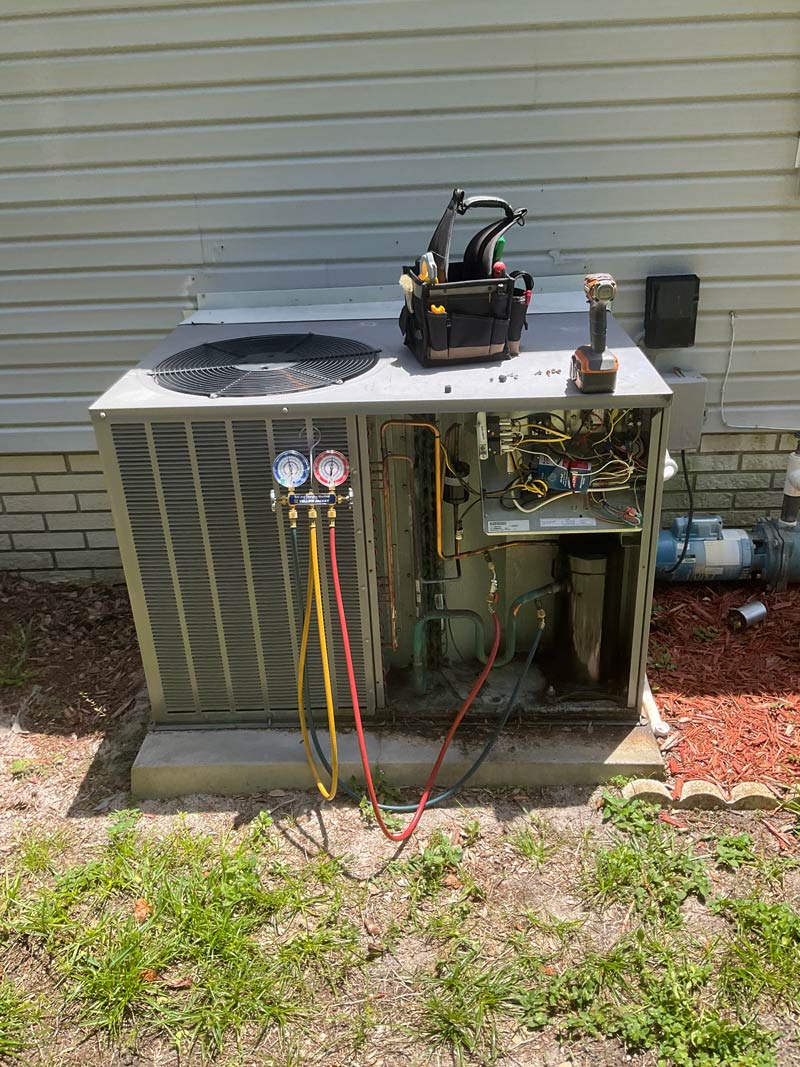

In a densely built neighborhood like Florida Ridge, where homes sit close together on smaller lots with limited shade and plenty of heat-absorbing pavement and roofline, AC systems work harder than the thermostat setting alone would suggest. Spotting a problem early in this environment can be the difference between a manageable repair and a system that gives out completely on a 95-degree afternoon.
None of these should be written off as quirks of an older home. Each one is a signal that something specific is wrong, and a proper diagnostic visit will tell you exactly what it is.
The homes in Florida Ridge were mostly built without the energy efficiency features that newer construction takes for granted. Minimal attic insulation, single-pane windows, and original ductwork that was never designed for today’s efficiency expectations all put extra load on the AC systems trying to compensate. When you layer in Indian River County’s subtropical heat and humidity, the result is equipment that ages faster and fails harder than it might in a newer or better-insulated home.
These failure patterns are common across Florida Ridge precisely because of the age and construction characteristics of the neighborhood, and understanding them is what lets us get to the right diagnosis without wasting your time.

Teresa called us on a Friday in August after her AC had stopped cooling the back half of her Florida Ridge home. The front rooms were tolerable, but the bedrooms down the hall were pushing 85 degrees by midday. She had replaced the filter a week earlier thinking that was the issue, but nothing had changed. When our technician got into the attic, the problem was clear. A section of flex duct serving the rear of the home had pulled loose at a connection joint, sending conditioned air straight into the attic instead of the back bedrooms. On top of that, the evaporator coil had a light layer of buildup that had been cutting into airflow efficiency for some time. We resealed the duct connection, cleaned the coil, and verified airflow to every register before leaving. Teresa texted us that evening to say the back of the house had finally cooled down for the first time in longer than she could remember. That kind of result is exactly what a proper diagnostic makes possible.
Florida Ridge is a neighborhood of working families and long-term homeowners who do not have time for HVAC companies that overpromise or underdeliver. Bates Air and Heat was built for exactly this kind of community, where trust is earned through consistent, honest service and not just a smooth sales pitch.
As a veteran-owned company, accountability is part of how we are wired. We do not cut corners, and we do not leave until the job is done right.


Uneven cooling like this is often a ductwork problem. In older Florida Ridge homes, flex duct connections in the attic can pull apart or develop leaks over time, diverting conditioned air before it reaches the far end of the house. It can also be caused by a dirty coil or low refrigerant reducing overall system output. A technician can trace the airflow and identify exactly where the problem is.
Attics in this area can reach temperatures well above 130 degrees during summer, and in homes with minimal insulation or older duct systems running through that space, the heat load on the AC is significantly higher than the thermostat reading suggests. The system has to work much harder to overcome that heat transfer, which accelerates wear on the compressor and blower components and drives up energy costs.
Ice on the refrigerant line or on the outdoor unit typically means the evaporator coil is not getting enough airflow, which is often caused by a clogged filter, a closed or blocked return vent, or a dirty coil. Low refrigerant can also cause freezing. You should turn the system to fan-only mode to let it thaw, then call for a diagnostic before running it again in cooling mode to avoid damaging the compressor.
Intermittent breaker trips are usually a sign that the system is drawing more current than it should, which can point to a failing compressor, a seized fan motor, or an electrical fault in the unit itself. It can also mean the breaker itself is worn. Either way, it is not something to ignore since a failing component that trips a breaker today can cause more serious damage if it runs to full failure. Have it checked before it gets worse.
For older homes in this area, a maintenance plan is genuinely one of the better investments you can make in your HVAC system. Aging equipment with years of accumulated wear benefits significantly from regular cleaning, component checks, and drain service. Catching a failing capacitor or a slow refrigerant leak during a scheduled visit costs far less than the emergency repair or compressor replacement that follows if those issues go unnoticed.